
Practical Gastroenterology 2/2026
- ACG Guidelines – Perioperative Risks and Management of Patients with Liver Cirrhosis
- AGA Clinical Practice Update on the Management of Ascites, Volume Overload, and Hyponatremia in Cirrhosis: Expert Review – A Discussion of the Guidelines
- An Overview of U.S. Nutritional Recommendations for Liver Disease. ACG Clinical Guideline: Malnutrition and Nutritional Recommendations in Liver Disease 2025
- Rapid Weight Loss in Patients with MASLD—Benefits and Risks
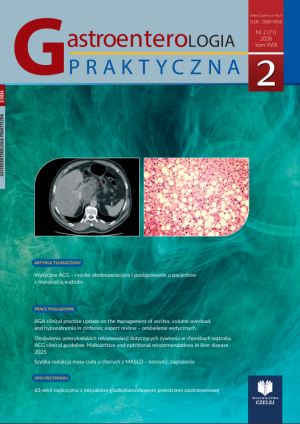
- A 63-year-old man with retroperitoneal leiomyosarcoma
ACG Guidelines – Perioperative Risks and Management of Patients with Liver Cirrhosis
ACG Clinical Guideline: Perioperative Risk Assessment and Management in Patients with Cirrhosis
Nadim Mahmud, Zachary P. Fricker, Lisa M. McElroy, Emad Qayed, Robert J. Wong, George N. Ioannou
Abstract
The following guidelines are intended to present a comprehensive approach to perioperative assessment and surgical management in patients with liver cirrhosis. Due to the specific risk factors present in this patient group, these guidelines emphasize a multidisciplinary approach to preoperative evaluation, perioperative care, and postoperative monitoring. In developing these guidelines, special attention was paid to the severity of liver disease, comorbidities, and factors specific to the surgical procedure, including the use of validated scales—such as the VOCAL-Penn scale—to enable individualized risk stratification for surgery. The following recommendations highlight key aspects of the preoperative management strategy, including appropriate nutritional therapy, treatment of portal hypertension, correction of coagulation disorders, and treatment of frailty and sarcopenia. In patients with decompensated liver cirrhosis, the creation of atransjugular intrahepatic portosystemic shunt (TIPS — TIPS) may reduce portal pressure and the risks associated with surgery. Elective surgeries, such as cholecystectomy or abdominal hernia repair, are recommended in a selected group of patients with compensated cirrhosis. If there is a high perioperative risk, alternative treatment methods should be considered. The guidelines emphasize the importance of performing surgery at large centers with experience in treating patients with liver cirrhosis and stress the need for a multidisciplinary approach when making decisions about surgery based on an objective risk assessment. In addition, the recommendations address specific issues related to particular surgical procedures, including bariatric and cardiac surgeries in this patient population. Based on scientific evidence and expert opinions, these guidelines aim to improve surgical outcomes and enhance clinical decision-making in the growing population of patients with liver cirrhosis undergoing surgery.
AGA Clinical Practice Update on the Management of Ascites, Volume Overload, and Hyponatremia in Cirrhosis: Expert Review – A Discussion of the Guidelines
AGA Clinical Practice Update on the Management of Ascites, Volume Overload, and Hyponatremia in Cirrhosis: Expert Review – Overview of the Guidelines
Anna Parfieniuk-Kowerda
Abstract
In 2025, the American Gastroenterological Association (AGA) presented an update to its guidelines for the management of liver cirrhosis complicated by ascites, fluid retention, and hyponatremia. The AGA’s recommendations for best clinical practice were concisely developed based on a review of the published literature and expert opinion, and were approved by the AGA’s Board of Directors and a designated scientific committee of experts. Because the stage of conducting formal systematic reviews was omitted, these recommendations were not assigned official assessments of data quality or the strength of the presented evidence. The AGA guidelines presented in this article are discussed in detail while maintaining the original structure of the AGA recommendations and are analyzed in relation to the 2018 recommendations of the European Association for the Study of the Liver (EASL) — EASL) regarding the treatment of decompensated cirrhosis from 2018 and nutrition in cirrhosis from 2019, as well as practical aspects related to healthcare and the availability of medications and therapeutic procedures in Poland.
Abstract
In 2025, the American Gastroenterological Association (AGA) issued updated guidelines on the management of cirrhosis complicated by ascites, fluid overload (fluid retention), and hyponatremia. The AGA’s best-practice clinical recommendations were formulated concisely based on a review of the published literature and expert opinion, and were approved by the AGA governing board and its designated scientific expert committee. Because a formal systematic review process was not conducted, these recommendations were not assigned official ratings of evidence quality or strength. The AGA guideline presented below is discussed in detail, retaining the original structure of the AGA recommendations, and is analyzed in relation to the 2018 recommendations of the European Association for the Study of the Liver (EASL) on the management of decompensated cirrhosis and the 2019 EASL recommendations on nutrition in cirrhosis, as well as in relation to practical considerations regarding healthcare delivery and the availability of medications and interventional procedures in Poland.
An Overview of U.S. Nutritional Recommendations for Liver Disease. ACG Clinical Guideline: Malnutrition and Nutritional Recommendations in Liver Disease 2025
Review of the ACG 2025 Clinical Guideline on Malnutrition and Nutritional Recommendations in Liver Disease
Dagmara Bogdanowska-Charkiewicz
Abstract
The American College of Gastroenterology (ACG) from 2025 on malnutrition and nutritional recommendations in liver disease emphasize the importance of assessing nutritional status and providing early nutritional intervention in patients with chronic liver disease, particularly those with cirrhosis, alcohol-related liver disease, and metabolic-associated steatohepatitis (MASH). Malnutrition, including sarcopenia and sarcopenic obesity, is a common and underdiagnosed complication that worsens prognosis, increases the risk of complications, prolongs hospitalization, and adversely affects treatment outcomes before and after liver transplantation. The guidelines highlight the limited usefulness of traditional anthropometric and laboratory markers and recommend routine assessment of muscle mass and strength. Among the most important recommendations are: early initiation of oral or enteral nutritional support, avoiding protein restriction even in patients with hepatic encephalopathy, preferring plant-based protein in selected patients, the use of branched-chain amino acids (BCAAs), and the introduction of late-evening snacks to reduce nocturnal catabolism. The document emphasizes that nutritional therapy should be an integral part of comprehensive hepatological care.
Abstract
The 2025 American College of Gastroenterology (ACG) guideline on malnutrition and nutritional recommendations in liver disease emphasizes the central role of nutritional assessment and early nutritional intervention in patients with chronic liver diseases, particularly cirrhosis, alcohol-associated liver disease, and metabolic dysfunction-associated steatotic liver disease (MASH). Malnutrition, including sarcopenia and sarcopenic obesity, is a common and underrecognized complication that worsens prognosis, increases the risk of complications, prolongs hospitalization, and adversely affects outcomes before and after liver transplantation. The guideline highlights the limited usefulness of traditional anthropometric and laboratory markers and recommends routine assessment of muscle mass and muscle strength. The main recommendations include early initiation of oral or enteral nutritional support, avoidance of protein restriction even in patients with hepatic encephalopathy, preference for plant-based protein in selected patients, use of branched-chain amino acids (BCAA), and implementation of late-evening snacks to reduce nocturnal catabolism. The document emphasizes that nutritional therapy should be regarded as an integral component of comprehensive hepatology care.
Rapid Weight Loss in Patients with MASLD—Benefits and Risks
Rapid Weight Loss in Patients with MASLD—Benefits and Risks
Anatol Panasiuk
Abstract
Metabolic dysfunction-associated steatotic liver disease (MASLD) is currently the most common chronic liver disease worldwide and is one of the most significant complications of obesity and metabolic syndrome. Weight loss remains the primary treatment for MASLD, and its effectiveness in reducing hepatic steatosis, inflammatory activity, and fibrosis has been confirmed in numerous clinical trials. In recent years, there has been a dramatic increase in the number of patients achieving rapid weight loss through the use of glucagon-like peptide-1 (GLP-1) receptor agonists —GLP-1), dual agonists of glucose-dependent insulinotropic peptide (GIP) and GLP-1, very low-calorie diets, and bariatric surgery. Such intensive weight loss leads to a rapid decrease in fatty acid content in hepatocytes, improved insulin sensitivity, and regression of inflammatory and fibrotic changes. At the same time, it may increase the risk of lean body mass loss, the development of sarcopenia, gallstones and microlithiasis, nutritional deficiencies, and transient biochemical abnormalities. A growing body of evidence suggests that the efficacy and safety of therapy are determined not only by the degree of weight loss but also by the rate of weight loss and the composition of the lost mass. In patients at high risk for biliary complications, it is reasonable to consider the prophylactic use of ursodeoxycholic acid (ursodeoxycholic acid—UDCA), whose effectiveness in reducing the risk of gallstones and microlithiasis during intensive weight loss has been confirmed in clinical trials.
Abstract
Metabolic dysfunction-associated steatotic liver disease (MASLD) is currently the most common chronic liver disease worldwide and one of the most significant complications of obesity and metabolic syndrome. Weight loss remains the primary treatment for MASLD, and its efficacy in reducing hepatic steatosis, inflammatory activity, and liver fibrosis has been confirmed in numerous clinical trials. In recent years, the number of patients achieving rapid weight loss through the use of glucagon-like peptide 1 (GLP-1) receptor agonists, dual glucose-dependent insulinotropic peptide (GIP) and GLP-1 agonists, very-low-calorie diets, and bariatric surgery has increased dramatically. Such intensive weight reduction leads to a rapid decrease in hepatocyte fatty acid content, improved insulin sensitivity, and the regression of inflammatory and fibrotic changes. Simultaneously, it may increase the risk of lean body mass loss, sarcopenia, gallstone disease and biliary microlithiasis, nutritional deficiencies, and transient biochemical abnormalities. Growing evidence indicates that the efficacy and safety of therapy are determined not only by the degree of weight loss but also by the rate of weight loss and the composition of the lost mass. In patients at high risk for biliary complications, it is appropriate to consider the prophylactic use of ursodeoxycholic acid (UDCA), whose efficacy in reducing the risk of gallstone formation and microlithiasis during intensive weight loss has been confirmed in clinical trials.
A 63-year-old man with retroperitoneal leiomyosarcoma
Retroperitoneal leiomyosarcoma in a 63-year-old patient with abdominal pain
Rafał Kucharski, Julia Arct, Kamila Milewska, Andrzej Dąbrowski
Abstract
Retroperitoneal leiomyosarcoma (RLMS) is a rare malignant tumor for which treatment options are limited and the prognosis remains poor. We report the case of a 63-year-old man who presented to the hospital emergency department with abdominal pain. A computed tomography (CT) scan revealed a retroperitoneal mass (51 mm × 96 mm × 105 mm) invading the inferior vena cava. Biopsy and histopathological examination results confirmed the diagnosis of leiomyosarcoma. Over the course of 13 months, four consecutive lines of systemic therapy were administered: chemotherapy according to the ADIC protocol, gemcitabine with docetaxel, trabectedin, and pazopanib. During the first 3 months of the disease, the patient experienced three episodes of thromboembolism. This article highlights the challenges in the diagnosis and treatment of such a rare cancer.
Abstract
Retroperitoneal leiomyosarcoma (RLMS) is a rare malignancy with limited treatment options and a poor prognosis. We report the case of a 63-year-old man who presented to the emergency department with abdominal pain. Computed tomography (CT) revealed a retroperitoneal mass (51 mm × 96 mm × 105 mm) invading the inferior vena cava. Biopsy and histopathological examination confirmed the diagnosis of leiomyosarcoma. Over a period of 13 months, four successive lines of systemic therapy were administered: ADIC-protocol chemotherapy, gemcitabine with docetaxel, trabectedin, and pazopanib. During the first three months of the disease, the patient experienced three thromboembolic episodes. This article discusses the challenges associated with the diagnosis and treatment of this rare tumor.
Standards for the Protection of Minors and Expanded Background Checks for Employees in Healthcare Facilities
Sylwia Kiełbasa